Notes from October 29, 2009 Meeting

ddsd_waitinglist_map_small

Represented in attendance:

4 – OKDHS/DDSD

7 – Parent, Family member or Self advocate

 1 – Agency

1 – Public School

2 – Oklahoma State Department of Education

Agency/Organizations represented: Center for Learning & Leadership/UCEDD, Oklahoma Infant Transition Program, OASIS, Apex, Duncan/Comanche School District, and Noble School District

Status of the Waiting List – Jim Nicholson

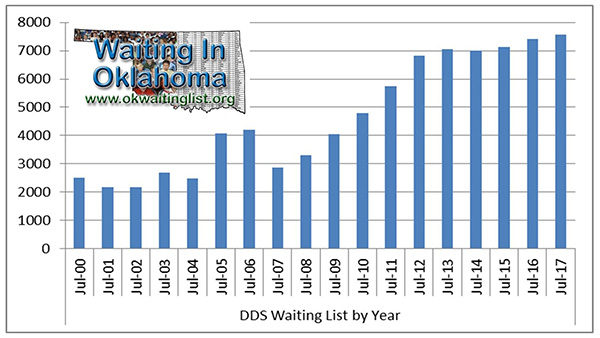
      As of 10/19/09 there are 5150 on the Waiting List

                  Waiting Time:

964 < 1 year

1020 – 1 to 2 years

1073 – 2 to 3 years

2093 > 3 years

April 26, 2004 is the date of the application that is up when funding becomes available.

A Few Words From the Director – Howard Hendrick

Director Hendrick discussed the funding shortfall that is affecting the state, thus affecting OKDHS.  He said as of this time, they have not cut any direct support to individuals receiving Waivered services and there are no plans to make this kind of cut. He did say they have had to make some adjustments to other programs serving individuals with developmental disabilities, though. He was asked if he felt the Family Support Subsidy Payment would be the affected the state’s current budget difficulties, and he said, not at this time.  He said that by the next meeting, he should have a better idea of affect the current state revenue has on OKDHS’ programs.

High School Graduation for Students with Developmental Disabilities – Amy Daugherty and Anita Eccard, State Department of Education, Special Education Services

                  Ms. Daugherty began by explaining that there is no state policy to graduate students at any specific time. She added that schools are monitored in their graduation performance but not specific to those on IEP’s. She said that if a school falls below the state “drop out” rate, which would include students on IEP’s who graduation date is pushed back for need, then that school is given a notice of needed improvement. She referred to this as “graduating in a timely manner”.  She said all districts are monitored by a data profile for graduation and this is where the information is collected regarding students graduating in a timely manner.  There is no difference in this data for those on IEP’s and those in traditional class settings. 

      Ms. Daugherty continued by saying that the state requires all students to pass a test to graduate and those students with the most severe disabilities will need to pass the portfolio assessment before graduation.  She said if these students do not pass this portfolio assessment they can not graduate and they will need to do this assessment until passage which will allow them to graduate. 

      Both Ms. Daugherty and Ms. Eccard encouraged families to utilize the IEP team to the fullest.  They both mentioned the need for the team to decide at what rate the student would be able to meet each class requirement. The example given was that some students learn at a slower rate, thus they may require more time to achieve their full year credit, meaning they progress about half of what is typical for students. Again, they encouraged families to invite all who know the student and their abilities and strengths to be members on the IEP team. 

      Also, mentioned from the representatives of the State Dept. of Education was that our state has moved the requirement for IEP transition from 14 years old back to 16 years old. There was some discussion of this change due to the fact some parents didn’t know there had been a change of this magnitude.

      Ms. Daugherty did say that nowhere in IDEA does it say that a student must go to school until they are 21 years old. This decision is left up to the IEP team.

Lastly, a parent asked if Oklahoma has different types of diplomas for students in Special Education and those in traditional education classes.  Ms. Daugherty said, no not at this time.  All students graduating from an Oklahoma Public School will receive the same diploma as the next. 

Schedule Next Meeting 

                  January 28, 2010 at 2:00 

      It was mentioned that there could be a possibility to have a teleconference for the next meeting, but arrangements have not been completed as of yet.

Notes from July 23, 2009 Waiting List Meeting

 ddsd_waitinglist_map_small 

2.      Introductions

            Represented in attendance:

5 – DHS/DDSD

1 – House of Representatives

19 – Parent, Family member or Self advocate

2 – Agency & Direct Care Staff

(9 – First time attendees)

Attendees were from:

Norman, Noble, Edmond, McLoud, Oklahoma City, Anadarko, Yukon, N of OKC

Agency/Organizations represented in attendance: Oklahoma Infant Transition Program, OASIS, Oklahoma Family Network, APEX, Inc, Big Five Community Services, Oklahoma Family Support 360’ Program, Oklahoma SoonerSUCCESS

3.      Status of the Waiting List – Jim Nicholson

As of 7/16/2009

            4,905 Waiting for services

           When fund become available they will start working applications dated April 24, 2004.

That’s Greater than a 5 year wait for services!

            288 added during most recent quarter

            8 began receiving The In-Home Supports Waiver

            24 began receiving Community Waiver

            15 applications closed (not added to the waiver)

            Waiting Time Reported:

>3 years – = 1,857 38%

2 – 3 years – 992 = 20%

1 – 2 years – 1,083 = 22%

<1 year – 973 = 20%

      4. Director Hendrick spoke in detail about the budget and how some of the stimulus money is being use to offset the poor state review.  He also reported that the Office of State Finance just recently released a report saying that the state review collection is even lower than anticipated, which in turn will affect the state budget even worse.  He reported that OKDHS has approved more than 400,000 people for the Food Assistance Program (food stamps).  This is an all time high, but it is also evidence of our state’s economy.  He explained if at any point programs have to be cut or reduced or affected by the economic crisis, the first programs most likely to be reduced will be the programs that received little to no federal match, meaning the programs that are “state funded” only.  One of the “state funded” only programs mentioned that would be a huge loss for our state and the citizens if this happened is the Advantage Program, the program supporting elderly citizens to help them continue to live in their own home and not be required to move to a nursing home.  He said that programs like the Food Assistance Program, child daycare assistance, and even DDSD programs have high federal match, so it would really hurt our state if these programs were cut. 

He did explain to the group how his agency, OKDHS, has gone about reducing their over head in order to not have to cut programs or staff.  He said they have inacted a hiring freeze, they have just about reduced all travel, they have charged each of the State Resource Centers, Northern Oklahoma Resources Center in Enid, and Southern Oklahoma Resource Center in Pauls Valley, to eliminate overtime to staff, which seems to be a huge cost to each of those institutions.  He reported that these two centers are one of the highest cost to the DDSD program.  One parent asked if it would be possible to combine these two institutions, to help combine some cost, but continue to offer this support for those families who have already chose to place their family member there?  He said that they, OKDHS, is looking at all possibilities to reduce the cost for these centers.

Director Hendrick and Jim Nicholson both talked about some of the benefits DDSD continues to support.  Some of the programs that supports families directory which hold contracts with DDSD is the Oklahoma Autism Network, Oklahoma Family Network, Oklahoma Family Support 360’ program, and many others.  They both made sure to mention that there has been no reduction rate paid per hour for direct care staff, or they have not had to change eligibility in programs, either. 

5. Self Directed Services for the In-Home Supports Waiver.  Jim Nicholson explained that the SDS policy had passed the Policy Advisory Committee for DDSD.  He said the it has to pass two different committees or boards for the Health Care Authority then it will be available.  He also said they have prepared a “Request for Proposal” (bid request) looking for a financial manager.  It is thought to take about two months to get that part completely finished.  He concluded by saying, he’s best guess that the self-directive services part of the IHSW would not be available until as late as January 2010. 

6. Family questions & comments:

 One family brought up an issue that seems to be growing in our state.  This family talked about two young adult children, one living in Poteau and one living in Muskogee area, that are both on the Waiting List for services.  Neither of these families knew about DDSD programs until after their child graduated from high school.  That is when the families made application and was place on the waiting list. Both of these individuals have significant disabilities and can not be left alone. One parent is a single parent who is also caring for an elder parent, as well.  The other one is a much older parent trying to support their adult child with no outside support.  Each of these are situations that should have been noticed prior to them leaving high school, but were missed.  Mr. Nicholson said that he is requesting for a link on the front page of OKDS website, that would be for anyone who just receives a “disability” diagnosis.  This could give them step by step instructions to what is available and how to obtain applications.  This was thought to be a good idea.

Another family brought up yet another “trend” in our state with high school graduation.  Students with severe disabilities are “graduating” as if they were in traditional classes. Meaning they are graduation at the age of 18 instead of how it was traditionally done, graduating at 21.  There was some discussion about this with several of the families, the director and actually the representative who attended.  It was explained that schools are saying because of the “No Child Left Behind” policy that schools could receive a lower rating if they “hold” too many students back.  So these students are receiving their course credits, 4 years English, 3 years Math, 3 years, History, etc thus they meet the requirements for graduation so they must graduate.  They did discuss the “transition” part of the IEP’s but many of the parents said these still do not help because the students who are being kicked out of high school, without any place to go.  The director asked about the “exit” testing for each of these students, and it was explained that students with severe disabilities, who are not “testable” can opt out of testing and in place a portfolio be produced to see the “modifications” for this student.  An example of a portfolio was given, the child is non-verbal with limited communication skills, additionally blind, and high medical complications. The portfolio showing “History” showed pictures of the family where the teacher or assistant drew lines to each picture that is glued on the page and explained it’s a Family Heritage Tree.  The portfolio would also show the student holding scissors, but the student would rarely use scissors at any othe time.  There was continued discussion about how this increasing process, graduation students at 18 instead of 21, will continue to cause a drain on the system.  It has been requested that this matter be looked into more thoroughly.  Director Hendrick also requested that someone from the State Department of Education, Special Education Division, be invited to the next meeting to help us better understand this situation.

7. Next meeting is scheduled for October 29, 2009 at 2:00, same location.

Posted in Oklahoma DDSD Waiting List Meetings. Comments Off

Notes from January 14, 2009 Waiting List Meeting


 ddsd_waitinglist_map_small

      Introductions

            Represented in attendance:

5 – DHS/DDSD

2 - OHCA (Oklahoma Health Care Authority)

1 – House of Representatives

12 – Parent, Family member or Self advocate

2 – Agency & Student


(6 – First time attendees)


Agency/Organizations represented in attendance: Oklahoma Infant Transition Program, OASIS, Oklahoma Family Network, Systems of Care, Oklahoma LEND, APEX, Inc and Muscogee (Creek) Nation


     Status of the Waiting List – Jim Nicholson

As of the end of Fiscal Year 2009 first quarter

            4,243 Waiting for services

            297 added during the first quarter

            27 began receiving The In-Home Supports Waiver

            44 began receiving Community Waiver

            43 applications closed (not added to the waiver)


            Waiting Time Reported:

>3 years – 1,148 = 27.05%

2 – 3 years – 946 = 22.3%

1 – 2 years – 1,077 = 25.38%

<1 year – 1,072 = 25.27%


It was reported that funding was virtually stopped 12 – 18 months ago for individuals on the waiting list.  There was a one time fund available at the end of last year’s legislative term.  That allowed about 80 individuals to come off the waiting list.  There didn’t seem to be much hope for funding to support those waiting on the list.  The expected funding shortfall for all state agencies seems to have caused the lack of hope. 


One person brought up the need for the Self Directive Services (SDS) option to the Waiver programs to move forward.  Mr. Nicholson gave a brief update on the Self Directive Services.  He said the Oklahoma Health Care Authority (OHCA) and DDSD had a conference call with CMS (Centers for Medicare and Medicaid) and they feel like they have ironed out all the concerns CMS has regarding SDS. OHCA has send the needed information back to CMS and are awaiting the decision.  It was also explained that the idea behind SDS is to allow families or individuals to eliminate the agency if they desire.  This would allow for an increase pay to the direct care staff, and could potentially increase the amount of support a budget would be able to provide.  It was also discussed by a family member that when this is finally moved to those on the Community Waiver that it could be a cost savings to the state and not decrease the support already provided to the individual.  One family said they already do the job search and virtually the hiring and firing of the direct care staff, and self direction would allow for an increase in hour wages for the staff. 


      Update on TEFRA – Sue Robertson or Debbie Harmon (Oklahoma Health Care Authority)

TEFRA (Tax Equity and Fiscal Responsibility Act) is an option for families who’s income is too high to qualify for the state Medicaid (SoonerCare) program.  TEFRA does not look at the families income but only the child’s.  There is a level of care requirement along with cost qualification.  It was reported by Ms. Harmon, that if the cost for the child to stay at home exceeds the cost for the level of care at the respective institution, the child may not qualify under that criteria.  Ms. Harmon reported that 267 children are now receiving SoonerCare under the TEFRA program.  OHCA added 98 children in the past year.  For more information follow this link: http://www.okhca.org/individuals.aspx?id=172&menu=42&column=true&part1=554&part2=550&part3=552

It was requested to DHS/DDSD to send out notices to all person’s on the waiting list under the age of 18 information regarding TEFRA and information about where to apply.


     Family Questions & Comments

Some discussion from families:  there was some conversation regarding the Family Support Assistance Payment (FSAP) program, which offers to families a check for about $250.00 a month who has a child under 18 with a developmental disability and who are not receiving DDSD Waiver supports.  Additionally, there is a Respite Voucher Program which offers respite vouchers to families who are not receiving FSAP or the waiver program vouchers in the amount of $400.00 every quarter.  The income limit for families on the FSAP is $45,000 a year and the limit for the Respite Voucher program is $60,000.  This seems to exclude a number of families who are working middle class.  It was discussed that the income limits might need to be recalculated to better match today’s income levels.  It was also proposed that the families possibly be given some of both and not limit it to one.

Family Support Assistance Program: http://www.okdhs.org/programsandservices/dd/commsvcs/famsupp/default.htm

Respite Vouch Program: http://oasis.ouhsc.edu/voucher.htm


There was also some discussion regarding the waiting list and the process of adding individuals to the waivers.  One family proposed consideration for a “tier” system in regards to needs.  The example was given if an individual high on the list only needs limited supports, but someone way down on the list is in high need of support, there might need to be a better system of determining needs. 


There was some discussion around the possibility of looking at income and the ability to pay for some supports or even possibly a co-pay system for those with higher income.  The example was given, since the Waiver Programs only considers the individuals income and the income of the family, a family could potentially have an income of a million dollars and the individual receive the same services as a person whose family income is in the poverty level.  Additionally, it was mentioned that considering families income to determine addition to the Waiver Programs might be considered.  If a family can pay for and is currently paying for a service, then this might need to be considered. 

(editor’s note: While I feel we are approaching a potential financial crisis in our state, looking at ways to improve supports for individuals with disabilities is a priority, we need to consider all aspects before our state jumps on a change without looking at all consequences.  I respect the fact we must improve our system, I want to make sure we don’t jump without complete family involvement and input.)


One family brought up the issue of the absence of day care for those individuals between the age of 12 and 21.  For families who continue to work and support their child with a disability finding qualified people care for their child during working hours is nearly impossible.  One family spoke about that on most given days her son is moved from one home to another program, to another home to “patch work” care in order for her to continue to work.  There was some discussion on the idea that possibly schools could receive DHS child care supplement to support an after school program for this population of students.


     Schedule Next Meeting  Notice change in meeting room

April 29, 2009

Wednesday

1:00 PM

Sequoyah Memorial Office Building

4th Floor South Conference Room

ddsd_waitinglist_map

ddsd_waitinglist_map

Posted in Oklahoma DDSD Waiting List Meetings. Comments Off

Notes from October 15, 2008 meeting

Notes from the Waiting List Meeting

Oct. 15, 2008

1:00 pm


Represented in attendance:

4 – DHS/DDSD

0 - OHCA (Oklahoma Health Care Authority)

18 – Parent, Family member or Self advocate


(8 – First time attendees)


(Agencies/Organizations represented by family member in attendance – Center for Learning and Leadership/OU Health Science Center, OASIS, Down Syndrome Society of Central Oklahoma, Oklahoma Infant Transition Program, OASIS, Noble High School, Apex, Family Support 360 & Hispanic Mother’s Support Group)


Area’s represented by attendance:

  • Norman
  • Noble
  • Edmond
  • Oklahoma City
  • Blackburn
  • Anadarko
  • Midwest City
  • Yukon

Families waiting or receiving DDSD services:


11 families/individuals on the DDSD Waiting List

7 families receiving DDSD services

Posted in Oklahoma DDSD Waiting List Meetings. Comments Off

Notes for July 30, 2008 Meeting

Notes from the Waiting List Meeting

July 30, 2008

1:30 pm


Represented in attendance:

4 – DHS/DDSD

1 – OHCA (Oklahoma Health Care Authority)

18 – Parent, Family member or Self advocate


(5 – First time attendees)


(Agencies/Organizations represented by family member in attendance – Center for Learning and Leadership/OU Health Science Center, OASIS, Down Syndrome Society of Central Oklahoma, Oklahoma Infant Transition Program, OASIS, SoonerSUCCESS & OASIS)


Area’s represented by attendance:

  • Norman/Noble
  • Edmond
  • Oklahoma City
  • Pawnee
  • Tulsa
  • Guthrie


Families waiting or receiving DDSD services:

10 families/individuals on the DDSD Waiting List

8 families received DDSD services


Status of the Waiting List – There are currently 4,069 on the Waiting List as of July 14th.  DDSD is working applications dated April 26, 2004.  Jim Nicholson reports that due to the state’s budget problems the waiting list is virtually stalled.  But with that being said, he also reported that at the end of the legislative session that the Governor and the Senate and House leaders sent DHS $500,000 specifically for the Waiting List.  Mr. Nicholson feels this is a direct result of families informing their legislators and advocating for more funding for those on the waiting list.  (Side note – if you were one of the families who called during that last week, pat yourself on the back, if you weren’t next time I’m sure we’ll be able to count on you.  Additionally, please call those you spoke with that week and thank them for listening and supporting our families.  This is a must if we want to continue to have the legislators respect us when we call them with our needs).  Mr. Nicholson also reported that with this funding they are currently working 80 applications from the Waiting List.  I requested that when a final number of approved applications are finalized they send that information so I can get this information out to families.  It was also noted that families need to be aware that this money is a “one time” allotment and not a line item for the Waiting List.   It was also explained that DHS has made some budget adjustments to the Resource Centers to help support individuals receiving Home & Community Based Waivers.  One point of interest mentioned was that currently and for the next year, possibly, our state’s budget will continue to be negatively affected by the nation’s financial crisis, but there is some hope for the future since our state has a large number of business’ who are positively affected by the high energy cost, which will eventually have a positive affect on our state’s finances.  This isn’t expected until the end of next year.


Status of Self Directed Services – Jim Nicholson gave an update to the Self Directive Services pilot program.  They are currently working with Oklahoma Health Care Authority to finalize the amendment being sent to CMS (Centers for Medicare and Medicaid) for final approval.  He did note that once CMS gives its final approval there is still some technical steps before it can move to the full In-Home Supports Waiver.  Some of these things include sending out an invitation for bid to find a fiscal agent to provide the employment part of the payment process, and then they have to make needed adjustments to OHCA and OKDHS’ billing system to work with the SDS payment model.  There was no estimated time of implementation. 


Family Question & Comments: There was comments given regarding the difficulty families are having obtaining HTS staff for those receiving supports in their home.  It was mentioned that there is a staffing shortage across the board.  The situation mentioned was when an agency provides residential supports and supports for those living in their own home, the agency is required to provide someone to work in the residential setting regardless of the staffing issues.  What this causes is if a family has a staff working in their home and if the agency has a shortage in the residential setting, they will put the staff from the private home to fill their obligation at the residential setting.  This leaves families vulnerable and without staff during this staffing crisis.  It was also mentioned that it seems there is a new movement for agencies, which is taxing on families.  This new movement is to offer the family of being their own HTS support and get paid while there is a staffing shortage.  The problem with this is families are not receiving any relief or respite during this time.  Additionally, it was said that once the family accepts this situation, even for a temporary time, the agency seems to stop trying to obtain staff for that family.  (This is only happening with adults on the both IHSW and HCBW, not people under 18)  On this same topic there was some discussion regarding low pay for direct care staff (HTS) and that seems to be the reason for the staffing shortage.


Jim Nicholson reports that the agencies have a high over head cost to provide training to direct care staff.  They pay for staff hourly pay for time they spend in training and also hourly pay to cover the shift they are missing while attending the training.  He explained that starting August 1st that agencies will be giving the opportunity to participate in something called the “College of Direct Supports” which is a web based training for much of the required training.  He explained that training can be done at the convenience of the staff, and any place there is high speed internet access.  Mr. Nicholson also explained that this training option is not a requirement but only an option for agencies since there is a “start up” cost for those agencies who want to participate.  His hope is that once a few agencies come on board that other agencies will follow and find that this will be a way to reduce the high cost of training. 


One family asked about if they need to leave the state for a short time, whether for vacation or even to care of a sick family member, would this cause a problem with their waiver services.  Mr. Nicholson said this wouldn’t have an affect on waivered services, but to let the case manager, the agency and the direct care staff know so they won’t plan to come out and no one there.  It was asked would this be true for an extended amount of time out of state, example given was three months, and Mr. Nicholson said that shouldn’t be a problem.


Another family wanted clarification regarding the writing of the plan of care.  She explained that her daughter’s plan was written with an “exact” amount of hours for HTS for each week.  This mom explained that there are some weeks she may only need 4 hours but when summer comes around she might need as many hours as she can.  She was told by her agency that she can’t just “do it” even though she hasn’t used up her full amount of waiver units because the agency is at risk to have to pay the money back.  Ray Hester, DDSD, explained that when a plan of care is written up, the plan will have a “prescribed” amount of units per week for HTS.  He said the plan can be written in a way to not be so restricted in hours per week.  But he also said it can’t be written so loosely that it can’t be tracked to show needs.  (My understanding of what he said was the plan of care can have written something like 10 – 20 units of HTS per week.  If there is a time when more than 20 hours is needed the case manager will need to request an amendment to the original plan of care.  This may not be exactly correct, but its close)


Schedule Next Meeting – Wednesday, October 15, 2008 at 1:30 pm.


Posted in Oklahoma DDSD Waiting List Meetings. Comments Off

Notes from the Waiting List Meeting April 30, 2008

Notes from the Waiting List Meeting

April 30, 2008

1:30 pm


Represented in attendance:

4 – DHS/DDSD

3 – OHCA (Oklahoma Health Care Authority)

30 – Parent, Family member or Self advocate

2 – Agencies (SoonerSUCCESS, Phoenix Provider Agency – Tulsa)


(Agencies/Organizations represented by family member in attendance – Oklahoma Family Network, Center for Learning and Leadership/OU Health Science Center, OASIS, Oklahoma Family Support 360’ Center, Down Syndrome Society of Central Oklahoma, Oklahoma Infant Transition Program)


In attendance we had:

11 families/individuals on the DDSD Waiting List

18 families received DDSD services


Area’s represented by attenance:


Norman

Tulsa

Noble

Moore

Yukon

El Reno

Midwest City

Edmond

Pawnee

Stillwater

Oklahoma City


Status of the Waiting List – There are about 3,854 currently on the Waiting List. Jim Nicholson explained that the budget is at a “stand still”.  The Waiting List is not being worked and has not been worked in several months*.  There is no expectation for improvement because the budget for fiscal year 2009 approved by the Governor has the same amount of funding for DDSD as last year.


He was asked to explain why the waiting list will not be reduced once the fiscal year budget starts. He explained that due to the “federal match” being reduced and the budget from the state not being increased, OKDHS will have a significant loss in available funds.  Additionally, Jim Nicholson explained that the federal agency (CMS) which oversees the Medicaid and Medicare payments to each state had a policy change regarding how states can bill for and be paid for “targeted case management”.  This change in policy could have a financial impact to OKDHS estimated at 24 million dollars.  If this happens, this could be a huge issue in our ability to provide DDSD services to those on the Waiting List.  Jim Nicholson did reassure families that there is NO waiting list for families applying for the Family Support Payment which is funded through TANF dollars. 


There were several family members who were aware of the CMS policy change and explained that there is a legislation** currently approved in Congress but having issues in the Senate that would put a moratorium to “hold” this change in policy. 


Status of Self Directed Services – Jim Nicholson explained that Self Directed Services (SDS) is in the process of being added (amended) to the In-Home Supports Waiver, child and adult.  The Oklahoma Health Care Authority is currently making final adjustments before sending it to CMS (Centers for Medicare/Medicaid) for final approval.  It was explained that once CMS receives the request to amend the current waivers they will have 90 days to make a decision.  It was also explained that CMS can “freeze” that timeline if they need more information from Oklahoma to make a decision. 


TEFRA – Debbie Harmon, LPN from the Oklahoma Health Care Authority was present to explain TEFRA.  TEFRA*** (Tax Equity and Fiscal Responsibility Act) began in October 2005.  It provides Medicaid eligibility for children with high health care needs.  This program does not look at the family’s income, but rather only the child’s income.  Additionally, the child must meet one of three “high” levels of care qualifications to be eligible. Several families at the meeting have children that are difficult to test to obtain an IQ score but are known to have intellectual/cognitive disabilities.  Debbie Harmon explained that for the children who cannot have an IQ test performed and a doctor is not able to give an “estimated” IQ score; there are several ways a child can be evaluated.  She also explained that to qualify under the ICF/MR level of care the child must be “functioning” at least 50% lower than his/her chronological age.  For example, if a child is 8 years old and has an IQ above 70, they must be “functioning” at less than a 4 year-old level in order for the child to qualify for TEFRA under the ICF/MR level of care.  (This was a very technical section and it’s very difficult for me to put into words.  Please if you have any questions feel free to contact Wanda Felty)


Family Question & Comments: One family member discussed the change in her support staff due to them getting older.  She wanted to express her concern that the new staff she has to hire come through an agency as opposed to the staff she currently has which have a direct contract with Medicaid.  Utilizing an agency reduces the hours she can have staff due to the overhead of the agency.  It was explained to her that the federal agency (CMS) that oversees payments will not approve that program any longer.  Several families explained to her that Self Direction would be a similar program, but her children are both on the Home and Community Based Waiver, which will not have SDS at this time.


Another family discussed her issues with county DHS officials who are not familiar with different programs or policy.  She was told by her local office that families on the Waiting List cannot qualify for the Respite Voucher Program.  It was explained to her that people receiving any waiver service cannot qualify but those ‘waiting” can and should apply by calling OASIS 1.888.771.4550 local 271-4550.


Schedule Next Meeting – Wednesday, July 30, 2008 at 1:30 pm.


*According to OKDHS.org the waiting list is stalled working applications at or about April 7, 2004.

**H.R. 5613 – Protecting the Medicaid Safety Net Act of 2008

***More information at www.okhca.org TEFRA

Posted in Oklahoma DDSD Waiting List Meetings. Comments Off

Meeting notes from Jan. 16, 2008

Represented in attendance:
3 – DHS/DDSD
1 – OHCA (Oklahoma Health Care Authority)
1 – TARC
12 – Parent, Family member or Self advocate
Total – 17

Areas represented:
Norman
Oklahoma City
Pawnee
Stillwater
Tulsa

DDSD is currently working applications from April 7, 2004.  We were told the waiting list is virtually stalled at this time.  The only person’s moving onto Waiver services are those who are in DHS custody, those who meeting the Emergency guidelines or those in the Public Guardian program.  We were also told that during the month of December 2007 that a total of 34 people were removed from the waiting list.  Of those taken off the waiting list 21 began receiving services and 13 were either closed, declined, or were not eligible.  Also in the month of December 93 people were added back to the waiting list.  You need to note that some of those who “declined” did so because they were receiving the Family Support Payment which meets their needs at this time.  Thus would then be added to the bottom of the waiting list.  It was also said that of those on the waiting list only about 15% have been waiting for more than three years.Jim Nicholson discussed the issue of high cost to agencies for required training of HTS staff, and the high turnover/retention rate of staff as well.  One of the ways DDSD is trying to help with this issue if by contracting with an online training program what would allow HTS staff and agencies to train at times convenient to both.  The online training would also allow for the HTS to have access to all previous completed courses which will make moving from agency to agency a smoother and less costly transition.  This project is estimated to be released in the next 30 days.  Additionally, he said this training would be available to families as well.

Jim Nicholson explained that there is a Rate Review Committee which has met two times already.  The committee has prepared a report to take to the legislators suggesting a rate increase of $18 an hour for HTS.
Regarding the Self Directive Services pilot Jim Nicholson said that it is a slow process to begin offering the SDS to the IHSW.  Currently the Health Care Authority is finalizing what they need and then the amendment (request to add this to the IHSW) will be send to the National Centers for Medicare/Medicaid (CMS) for their approval.  Once the amendment is sent to CMS DDSD will begin training of their staff so when approval is received the next plan of cares will have the ability to choose SDS. 

One more note of interest.  It was said that dental services were added as eligible services for those on the Community Waiver as of October 2007.

Sue Robertson with the Oklahoma Health Care Authority,  Child Health Program Coordinator spoke about a request that has been sent to CMS requesting the expansion of eligibility for children (birth – 19) applying for Medicaid.  CMS is still in the process of reviewing and has not made a decision as of yet.  If the request is approved it will change the income eligibility from 180% of poverty to either 250% or 300%.  What this could mean to families, if you had applied for Medicaid in the past and were denied do to your families income being too high, you may qualify once this program comes into effect.  This would help many people waiting for services on the waiting list.

Someone had mentioned to Sue Robertson the difficulties some families are having at qualifying for TEFRA.  The point was made that to qualify for TEFRA under the ICF/MR (Intermediate Care Facility for persons with MR) the person must have an IQ score of 70 or below.  When a child under that age of 6 is applying they are having 1) difficulty in finding someone who will give an IQ score for a person that young and 2) affording the cost of these evaluation.  Director Hendrick said if the problem is affording a Psychologist to perform the evaluation, that DHS could possibly afford to have a Psychologist on staff to do these.  Also, he has asked Jim Nicholson and Sue Robertson get together and figure out what is the issue with getting kids qualified if they should qualify.

The next meeting is scheduled for April 30th at 1:30.


Posted in Oklahoma DDSD Waiting List Meetings. Comments Off